Cold Comfort Chicken

Baby, its cold outside! Storm Goretti hit us last night with wind, rain, snow – the whole works. It’s passed through, now, but left in its wake grey water and ice – not even a pretty picture of blue skies and blinding whiteness. All I want to do is cuddle down with the fire, my cat and a good book (as I am sure you do, too) and some comfort food to warm and sustain me. The following recipes should do just that – and the best is they are all one pot wonders so you don’t even have to do too much washing up!

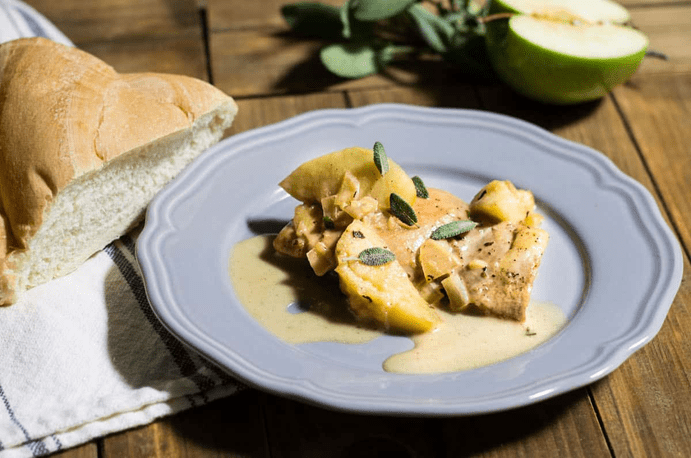
Normandy Chicken

  • 2 chicken thighs, skin on
  • 80g rindless bacon rashers, coarsely chopped
  • 1/2 leek, thinly sliced
  • 1 apple, peeled, cored, cut into wedges
  • 60ml apple cider or apple juice
  • 60ml chicken stock
  • 100ml  crème fraîche
  • 1 teaspoon Dijon mustard
  • chopped fresh sage, to serve (optional)

Preheat the oven to 200C/180C fan. Season the chicken. Place a large non-stick ovenproof frying pan over high heat. Cook half the chicken, skin-side down, for 4 minutes or until the chicken skin is golden. Turn and cook for 3 minutes. Transfer to a plate. Repeat with the remaining chicken. Drain and discard the fat from the pan. Return the pan to the heat. Add the bacon and leek. Cook, stirring occasionally, for 4 minutes or until the bacon is crisp. Add the apple and stir to coat. Add the cider or juice and simmer for 3 minutes or until reduced. Add the stock and thyme. Bring to a simmer. Return the chicken, skin-side up, to the pan. Place in the oven and cook for 40 minutes or until the chicken is tender. Transfer the chicken to a plate. Add the crème fraîche and mustard to the pan and whisk to combine. Place the pan over medium heat then return the chicken to the pan. Simmer for 5-10 minutes or until the sauce has thickened slightly. Sprinkle with sage, if using.

Chicken Piccata

  • 30g plain flour, seasoned
  • 2 small chicken breast fillets
  • 1 tbsp extra virgin olive oil
  • 20g butter
  • 1 shallots, thinly sliced
  • 1 garlic clove, crushed
  • 1 tsp fresh lemon thyme leaves, plus extra to serve
  • 125mls chicken stock
  • 30mls lemon juice
  • 150ml double cream
  • 1/2 small lemon, thinly sliced
  • 1 tbsp drained capers, rinsed
  • 1/2 tbsp chopped fresh flat-leaf parsley leaves
  • Mashed potato, to serve
  • steamed green beans, to serve

Toss the chicken in flour. Heat 1/2 the oil and 1/2 the butter in a large frying pan over medium-high heat. Add chicken to pan, shaking off excess flour. Cook for 4 to 5 minutes each side or until browned. Transfer to a plate. Add remaining oil and remaining butter to frying pan. Add eschalot, garlic and thyme. Cook, stirring, for 2 to 3 minutes or until eschalot has softened. Add chicken stock, lemon juice and cream to pan. Season with salt and pepper. Stir to combine. Bring to a simmer. Return chicken to pan. Reduce heat to low. Simmer, uncovered, for 10 to 12 minutes or until chicken is cooked through and sauce has slightly thickened. Add lemon slices to pan. Remove from heat. Sprinkle with capers, parsley and extra thyme. Serve with mashed potato and steamed green beans.

One Pot chicken with Spinach and White Beans

  • 20g plain flour
  • 1 teaspoon smoked paprika
  • 2 small chicken thighs (skin on)
  • 1 tbsp extra virgin olive oil
  • 1 small brown onion, finely chopped
  • 1 garlic cloves, crushed
  • 150mls chicken stock
  • 4 sprigs fresh thyme, plus extra sprigs to serve
  • 1 dried bay leaves
  • 1 dessertspoon lemon juice
  • Spinach, trimmed
  • 200g tin Cannellini Beans, drained, rinsed
  • 1 small courgette sliced, steamed, to serve
  •  broccoli, cut into florets, steamed, to serve

Toss the chicken to coat with flour and paprika mix. Heat oil in a large, heavy-based frying pan over medium-high heat. Cook chicken, in batches, for 3 minutes each side or until browned all over. Transfer to a plate. Add onion and garlic to pan. Cook, stirring, for 2 minutes. Add stock, thyme, bay leaves and lemon juice. Return chicken to pan. Bring to the boil. Reduce heat to medium-low. Simmer for 15 minutes. Remove and discard bay leaves. Add spinach and beans. Season with salt and pepper. Cook for a further 2 minutes or until spinach is just wilted and chicken is cooked through. Sprinkle with extra thyme. Serve with steamed courgette and broccoli.

Following on . . .

As the previous blog about slow cooking appears to have been a hit, this is a little bit of a follow on in that you can cook all of these and freeze the remainder for another day (or invite some friends over!)

We live in the country where, like it or not, there is a lot of shooting this time of the year.  If given any game birds, remember to respect them as a free range, organic piece of meat who has at least flown and been part of the countryside for most of its life. Cook them to the best of your ability and use all of it.

Pheasant Casserole with Apples

  • 25g butter
  • 2 tablespoon sunflower oil
  • Salt and pepper
  • 6 pheasant breasts, skinned (use the carcass to make stock with some carrots and onions and water)
  • 2 onions, thinly sliced
  • 150ml apple juice (cloudy is best)
  • 300 ml game stock – see above but you can also use a cube
  • 2 dessert apples, peeled and cut into wedges
  • 2 tablespoon double cream
  • 1 tablespoon lemon juice

Heat half the butter and all the oil in a non-stick frying pan until very hot.  Season the pheasant breasts and fry them in the hot pan until golden.  Set aside. Heat the remaining butter in the unwashed pan and fry the onions until tender – about 10 minutes. Sprinkle in the flour and gradually blend in the apple juice and stock. Bring to the boil stirring and add apples and breasts.  Cover and simmer over a low heat for about 12 minutes until the pheasant is just cooked through. DO NOT OVER COOK! Stir in the double cream and lemon juice and serve with mashed or baked potatoes and a green vegetable.

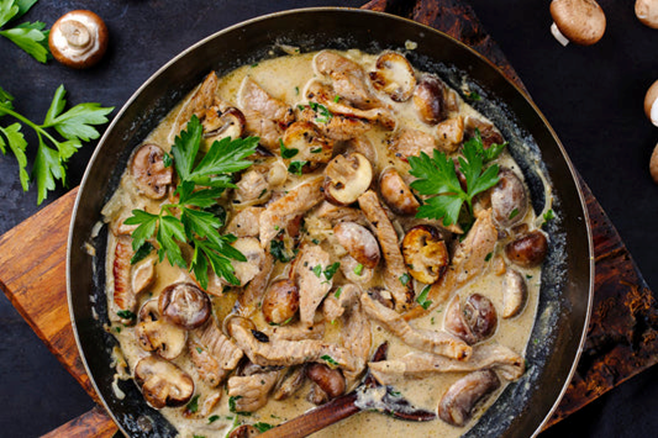
Pheasant Stroganoff – a quick and delicious way of using pheasant breasts.

  • 4 pheasant breasts, sliced
  • 1 shallot, finely chopped
  • 2 grated cloves of garlic
  • 6 – 8 chopped mushrooms
  • 200ml double cream
  • 2 teaspoons paprika
  • 4 cornichons, finely chopped
  • 1 tablespoon capers, finely chopped
  • 1 teaspoon grained mustard
  • Juice of 1 lemon
  • Salt and pepper
  • Handful of parsley, finely chopped
  • Pasta or rice to serve

Fry the pheasant strips on a high heat until they have a good colour. Put aside. Gently fry the shallot and garlic until soft, add mushrooms, then the cream, mustard and paprika and put the pheasant strips back in. Turn up the heat until they are simmering and the pheasant almost cooked through (you want it to be little pink or it will taste dry).  Add the cornichons, capers and lemon juice, seasoning and parsley.

Partridge with cider and cabbage

  • 1 tablespoon rapeseed oil
  • 4 streaky bacon rashers,      roughly chopped
  • 2 dressed partridges (you can try other game, too – even poussins)
  • 1 onion, finely chopped
  • 1 leek, sliced
  • 2 crushed garlic cloves
  • 2 tablespoons finely chopped thyme leaves
  • 300 ml medium dry cider
  • 2 tablespoon double cream or crème fraiche
  • ¼ savoy cabbage, finely shredded

Heat the oven to 180oC/gas4.  Heat the oil in an ovenproof pan and fry the bacon and birds for 4 – 5 minutes, turning until brown on all sides. Take out and add the onion, leek and garlic to the pan and cook, stirring, over a medium heat for 3 -4 minutes until starting to soften.  Return the partridges and bacon to the pan. Add the thyme and cider and put into the oven, cooking, uncovered for 20 – 25 minutes.  Take out of the oven and transfer the birds to warmed plates.  Stir into the pan the cream and cabbage and put over a medium heat to warm through – don’t let it boil! Season and serve with the partridges. ¼ savoy cabbage, finely shredded.

Sloooow Cooking

When I started this blog, I didn’t want us to do any batch cooking – I wanted everyone on their own to enjoy the shopping, the cooking and the eating of a meal but I have been asked recently to think about cooking in a slow cooker – so here you are!

Why slow cook?  Basically, once you have prepared all the ingredients and put them in the pot, the food can be left to its own devices, requiring minimal further effort , so you can go out for the day, spend time in the garden, paint a room – and return to a perfectly cooked meal.

Slow cooking makes economic sense, too, as it works best using cheaper cuts of meat and inexpensive staples such as beans and lentils.  It is also easy to cook larger quantities at once, creating leftovers for another day or to freeze.

With colder times approaching, stews, casseroles and pot roasts are real comfort food – and you might not have thought of doing them just for yourself so this way you can be really organised for a meal for today  and think ahead to another week.

Energywise, slow cooking is greatdon’t be put off when you see the recipe saying switch on and slow cook for 8 hours!

  • Cooking time: 8 hours
  • Energy used: 200 watts x 8 hours = 1600 Wh or 1.6 kWh 
  • Cost: If your energy rate is 20p per kWh, the cost would be 1.6 kWh x 20p = 32p. 

Tips for success

For maximum flavour, brown the meat at the start of the cooking ie lightly fry and soften aromatic vegetables such as onions and garlic in the same  pan afterwards.

Be careful not to over season as salty flavours become concentrated with slow cooking.  You ca always adjust at the end.

Peppercorns and seeds, such as cumin and coriander are best crushed before adding to the pot so they release their flavour slowly.

Woody herbs such as rosemary and thyme are robust enough to add at the beginning of cooking whilst delicate herbs like parsley towards the end.

Always add delicate ingredients that don’t need much cooking such as fish and seafood towards the end of the cooking time.

If topping up the liquid during the cooking, add HOT liquid to prevent lowering the cooking temperature.

Make sure all frozen ingredients are thawed and meats thoroughly defrosted before cooking.

If a recipe calls for milk add this for the last 30 minutes of cooking. Add any cream at the end.

Adapting recipes from conventional  cooking to a slow cooking. Look at the basic cooking time – but leave to cook for longer – low, if all day and high, for 3 – 4 hours.  A slow cooker will never boil dry. As a general rule, halve the liquid as it doesn’t evaporate. If at the end, it looks like too much liquid, put it onto high with the lid off.   You may need to reduce spices and herbs as their flavour becomes concentrated in the slow cooker.

MINESTRONE SOUP                                                                                   Serves 4 – 6

  • 2 tablespoon olive oil                                                  
  • 2 celery sticks, chopped
  • 2 carrots, chopped                                                       
  • 1 onion, chopped
  • 400g can chopped tomatoes                                   
  • can of cannellini beans (optional)
  • 750 ml hot chicken or vegetable stock                
  • 60g small pasta shapes
  • 4 tablespoons chopped parsley                             
  • 40g parmesan cheese

Heat the oil and cook the celery, carrots and onions until softened,  Stir in the tomatoes and their juice.  Transfer to the cooker and add stock. Cover and cook low 6 – 8 hours. Add the pasta (and beans, if using) for the last 15 minutes of cooking.  Stir in the parsley and parmesan.

MUSTARD CHICKEN CASSEROLE                                                       Serves 4 – 6

  • 2 tablespoons wholegrain mustard                      
  • 1 tablespoon English mustard
  • 2 tablespoons runny honey                                      
  • 8 chicken thighs (bone in, skin off)
  • 2 tablespoons olive oil                                                
  • 2 -3 onions roughly chopped
  • 2 – 3 cloves of garlic
  • 200g parsnips/200g carrots, peeled and chopped
  • 1 pint hot chicken or vegetable stock ( a cube is fine)
  • Herbs of your choosing / slices of lemon (optional)

Mix together the mustards and honey in a bowl. Season the thighs and smother them with the mustard mix.  Leave to marinate for ½ hour. Heat half the oil in a pan and add the chicken pieces, a few at a time. Cook for 6 – 10 minutes until golden.  Remove and set aside. Add the remaining oil and fry the onions for a few minutes, scraping up any of the chicken juices,  Add the carrots and parsnips. Put everything into the cooker, pour in the stock and add the chicken. Put the lid on and cook on low for 6 hours or High for 3 – 4 hours.

RED CABBAGE WITH CIDER                                                                   Serves 4

  • ½ red onion                                                                      
  • 1 large red cabbage
  • 1 apple, cored but not peeled, finely chopped
  • 1 teaspoon 5 spice powder  
  • 300ml cider    

Put the onion, cabbage, apple and 5spice powder into the cooker. Season. Pour in the cider and stir to mix well.  Cook on low for 8 hours or high for 4 hours.

Super Soups

October, and a sharp drop in temperature so we really need something warm and sustaining – and what could be better than soup?  I know it’s easy to open a tin, a packet or a carton, and, yes, some of them are very nice – but wouldn’t you like to make your own with fresh ingredients and no preservatives? Buy “wonky” veg / use it up the odd ingredient lurking in the back of the fridge or use up the end of spices or herbs

Of course, you can’t really make soup for one but this is one of those occasions when you do want to make more than you need for one sitting – a pot of soup sitting in the fridge when you want it should last the week – and you can vary it in lots of ways by what you add to it.

Extra touches you can add to Soups

Parsley    Sage         Rosemary        Thyme           Oregano            Basil         Coriander      Mint         

Kaffir Lime Leaves              Chervil              Chives

  • Single or Double Cream
  • Crème Fraiche
  • Yogurt
  • Sour Cream

Croutons – cube some bread and fry in butter

Croutes – French bread of slices of bread, brushed with olive oil and toasted in the oven

As above but rubbed with garlic

As above but covered in cheese and toasted

You can make your own stock, boiling up the carcass or bones of a roast dinner with some vegetables – but stock cubes are perfectly acceptable – there lots of good ones in the shops now.

Canned Beans eg cannellini / pulses eg dried beans and lentils / grains eg rice, pearl barley and couscous can all be added to bulk out simple soups.

How about you make one of the below, go for a walk in the lovely crisp air and come home to a bowl of soup.  Don’t forget to pick up a nice crusty bread to go with it – and you definitely want some nice butter to go on it – no margarine!

Broccoli and Stilton Soup – a “quickie” recipe as cooking time is less than 10 mins   Serves 4

  • 12oz broccoli, cut into small pieces
  • 14fl oz vegetable stock
  • 1 oz butter
  • 4 spring onions, sliced (or 1 leek)
  • 1 3/4oz Stilton, crumbled or to taste
  • 3 ½ fl.oz double cream
  • Salt and pepper
  • Pinch nutmeg

Put broccoli pieces into a glass bowl. Pour over stock. Cover the bowl with cling film and put in microwave. Cook for 4 minutes till tender. Heat a frying pan till hot and add butter. When it starts to foam, add onions and cook for 1 minute. Put cooked broccoli and stock in a bowl/blender. Add onions, stilton and cream and blend together. Transfer mixture to a pan and bring gently to a simmer.

Red Lentil and chilli soup Serves 4

  • 2 teaspoons cumin seed
  • pinch chilli flakes
  • 1 tablespoon olive oil
  • 1chopped red onion
  • 140g red lentils
  • 850ml vegetable stock
  • 400g can tomatoes
  • 200g can chickpeas*
  • Small bunch of coriander chopped
  • Greek yogurt to serve

* optional

Heat a large saucepan and dry fry cumin seeds and chilli flakes for 1 minute. Add oil and onion and cook for 5 minutes. Stir in the lentils, stock and tomatoes and bring to boil. Simmer for 15 minutes. Whiz the soup with stick blender or food processor until rough puree. Put back in pan and add chickpeas if wanted. Heat and stir in coriander. Serve with a dollop of yogurt.

Leek and Potato Soup with cheesy mustard croutons Serves 4

  • 10 grams butter
  • 2 leeks
  • 1 teasp dried tarragon (optional)
  • 1 large potato
  • 500 ml stock with boiling water and a stock cube
  • 30 grams watercress (optional)

Melt butter in a large pan and add chopped leeks and tarragon. Add the chopped potato and stock.  Bring to boil and cook until potato is soft.  Add the watercress if using, simmer for 3 minutes and blend till smooth. Preheat grill to high and toast 2 slices of bread/baguette until crisp.  Spread each slice with some Dijon mustard and top with some grated cheese (any kind you like) Put the soup into a bowl and top with a cheesy crouton and serve.

Carrot and Ginger Soup Serves 4

  • 1 tbsp oil
  • 1 large onion, sliced
  • 2 tbsp coarsely grated ginger
  • 2 garlic cloves, sliced
  • 500 grams of carrots
  • 850ml vegetable stock
  • little nutmeg

Heat the oil in a large pan, add the onion, ginger and garlic, and fry for 5 mins until starting to soften. Stir in the nutmeg and cook for 1 min more. Pour in the stock, add the carrots then cover and simmer for 20-25 mins until the carrots are tender. Scoop a third of the mixture into a bowl and blitz the remainder with a hand blender or in a food processor until smooth. Return everything to the pan and heat until bubbling. Serve topped with a little nutmeg.

You say tomato; I say tomahto

In the middle of a tomato glut! Why do tomatoes all become ripe at the same time? And, also, what about the ones which never turn red?  All the hard work of growing, looking after and nurturing them to end up with almost too many of the little red bombs!  Sun-warmed tomatoes picked straight from the vine are arguably the ideal way to enjoy tomatoes. What can you do with them once you’ve made gallons of soup and tomato sauce for the freezer, eaten them fresh, fried and baked and given away pounds?

Beefsteak tomatoes are best for these 3 recipes

Stuffed Tomatoes (1) Fish

  • 170g cooked leftover salmon fillet, flaked
  • 1 tbsp shredded smoked salmon
  • 1/2 tbsp ready-made mayonnaise
  • 1 garlic clove, crushed
  • 1/2 tbsp tomato ketchup
  • splash balsamic vinegar
  • 2 large firm tomatoes, cut in half from top to bottom, seeds removed and reserved
  • salt and freshly ground black pepper

Cut the tops off the tomatoes and scoop out the inside.  Lay cut side down on some kitchen paper. In a large bowl, mix together the flaked salmon, smoked salmon, mayonnaise, garlic, ketchup, scooped out tomato flesh and balsamic vinegar until well combined. Season, to taste, with salt and freshly ground black pepper and pile back into the tomato shells, using the tops as lids.

Stuffed Tomatoes (2) veggie

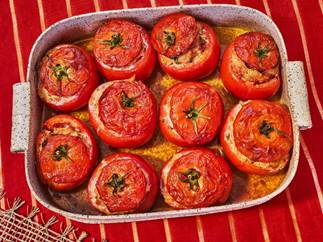
Cut off the tops, scoop out the insides as above. Bake in the oven for about 10 – 15 minute at 190 – 200oC.  Now add any chopped up (small) vegetables; left over rice, quinoa or couscous, herbs (parsley, mint or basil), garlic (of course).  Put all the ingredients you want in a bowl with the scooped-out flesh, mix well and put back into the shells.  You can put the lids back on or top them with breadcrumbs and or cheese.

Stuffed tomatoes (3) – meat

  • 2 – 3 tomatoes
  • 1 shallot, finely chopped125grams lamb mince
  • 15 grams fresh breadcrumbs
  • 150 grams button mushrooms, finely chopped
  • 1 tablespoon chopped fresh tarragon
  • salt and pepper
  • Sauce: 4 medium tomatoes, cut into quarters    25ml rapeseed oil    1 garlic clove chopped

Preheat the oven to 200oC/Gas6. Slice the tops off the beef tomatoes, reserving the tops as before.  Scoop out the flesh and put in a saucepan.  Mix the shallot, mince, breadcrumbs, mushrooms and tarragon in a bowl. Season. Stuff the tomatoes with the mince mixture (do not overfill as the mixture will expand when cooking and split the skin) , drizzle with oil and place the lids on top. Place the stuffed tomatoes in the oven and bake for 10 – 15 minutes. Sauce: Put quartered tomatoes into a saucepan, plus the flesh from the beef tomatoes.  Add oil and garlic, season and bring to the boil.  Simmer for 10 minutes.  Place the baked tomatoes on a serving plate and drizzle over sauce

Spaghetti with fresh tomato sauce

  • 200g spaghetti or linguine
  • 1 red chilli, deseeded and finely chopped
  • 2 shallots, finely chopped
  • 1 tbsp olive oil
  • zest of 1 lemon
  • 1 tbsp red wine vinegar
  • 2 tsp caster sugar
  • 300g tomato, diced
  • 125g ball mozzarella or burrata (see tip, below), torn into pieces
  • handful of basil leaves, torn, to serve

Cook the pasta following pack instructions. Meanwhile, put the chilli, shallots, oil, lemon zest, vinegar, sugar and tomatoes into a big mortar. If yours isn’t big enough, put it all in a bowl and just use the pestle in that. Add a good amount of sea salt and freshly ground black pepper and bash everything together. Drain the pasta and toss together with the tomato mixture and mozzarella or burrata. Scatter over the basil and serve immediately.

It’s worth getting hold of burrata – a softer, creamier relative of mozzarella – for this dish. It will go oozingly melty and create a sauce that clings to the pasta

Fried green tomatoes with garlic mayonnaise – a recipe for the ubiquitous green tomatoes – but is so good that if I were you, I wouldn’t wait for the end of the season but just use them when you have them, even if early on! If you haven’t got polenta, you can use flour, breadcrumbs or a thin tempura like batter instead. There is something quite perfect about the green-apple tang of an unripe tomato with the warm, mealy notes of crisp polenta. Serves two.

  • 4 medium to large green tomatoes
  • 2 eggs and a little milk
  • 90g plain flour
  • 3 tablespoons fine ground polenta
  • 2 sprigs of thyme
  • Oil for frying

Slice the tomatoes thickly, about three or four from each fruit. Break the eggs into a small, shallow bowl and beat them lightly. Stir in a tablespoon or two of milk. Mix the flour and ground polenta, season with salt and black pepper and the leaves pulled from the thyme branches. Tip onto a large shallow plate. Press a slice of tomato into the flour and polenta mixture then into the beaten egg then back into the polenta again. Shake off any excess. Don’t worry if bits of tomato show through here and there, you want a light, crisp coat, not armour-plating. Repeat with the remaining tomatoes. Warm the oil in a frying pan. Lower some the tomatoes into the pan, one at a time – otherwise they will stick together- then let them colour lightly on both sides. I turn mine after a minute or two. Cornmeal burns quickly, so I keep a watchful eye on the tomatoes as they cook. They should be ready in four or five minutes. Remove from the pan and drain on kitchen paper. Serve with garlic mayonnaise.

Sweet Tomato Jam is given a nice kick by the addition of ginger.

  • 2 tablespoons sunflower oil
  • 2 tablespoons grated ginger
  • 1 red onion, finely chopped
  • 1/2 cup (125ml) red wine vinegar
  • 1/2 firmly packed (100g) brown sugar
  • 1 small red chilli, finely chopped
  • 450g chopped tomatoes
  • 1 tablespoon honey

Heat the oil in a saucepan over medium-high heat. Add the ginger and onion, and cook for 2-3 minutes until the onion is soft. Add the vinegar, brown sugar and chilli, and cook, stirring, for 2-3 minutes until sugar dissolves. Stir in the tomatoes and season with salt and pepper. Bring to the boil, then reduce the heat to low and simmer, stirring occasionally, for 30-35 minutes until thick. Stir in the honey and cool to room temperature.

NB I know some of above is for more than one but now is the time to cook for more when you have so much to hand!

Summer Solstice

June 21st is the Summer Solstice and is often referred to as the first day of summer, and yet celebrations across the Northern Hemisphere at this time of year carry the name Midsummer, which is pretty confusing. Midsummer and the summer solstice are used interchangeably, but they refer to different things.

The solstice is the beginning of the astronomical summer that has been celebrated since ancient times as the longest day of the year, whereas Midsummer now refers to numerous celebrations that are held over the solstice period, between June 19 and June 24, with both pagan and Christian origins. Midsummer, as in the religious observances traditional in many countries, occurs close to the June or Summer Solstice. With celebrations originating in ancient times as a festival for the summer solstice, this could be where the name comes from. Bonfires were lit up to ward off evil spirits as the sun turned southward. If you only had the sun to measure time and dictate your hours of light, the longest day would feel like a mid-point before you make the descent back into winter.

The past few days’ weather has been glorious so instead of recipes for one, invite three friends round and follow the next few for the perfect Summer Solstice Dinner. 

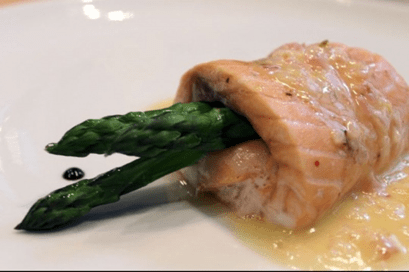
Salmon Rolls with Asparagus and Butter Sauce

  • asparagus spears
  • 4 thin salmon fillets
  • juice of a lemon
  • 2 small shallots, finely chopped
  • 6 peppercorns
  • 120 ml white wine
  • 4 tablespoons double cream
  • 200g butter, cut into small cubes
  • fresh parsley

Steam the asparagus for 6 – 8 minutes till tender, refresh under cold running water.  Lay on top of the salmon fillet and roll up.  Place on a rack over a pan of boiling water, sprinkle with lemon juice, cover and steam for 3 – 4 minutes till tender.

Sauce: Put the shallot, peppercorns and wine into a small saucepan and heat gently until the wine is reduced to a tablespoonful. Strain and return to the pan.  Add the cream and bring to the boil then lower the heat.  Add the butter to the sauce in small pieces, whisking all the time.  DO NOT ALLOW TO BOIL AS IT WILL SEPARATE! Season to taste, add a little parsley and serve with the salmon roll, some new potatoes and tenderstem broccoli and/or spinach.

Anything with basil immediately transports me to summer and the Mediterranean – sun, warmth and taste in one little green plant!

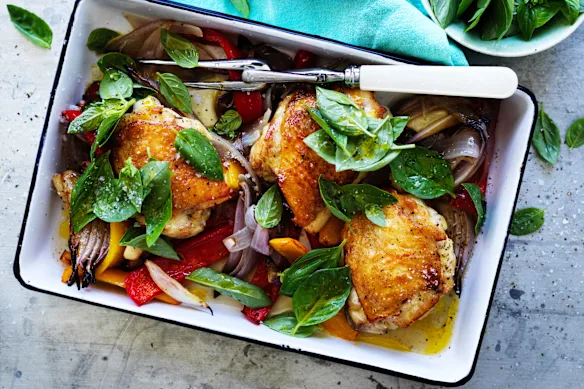
Chicken, Pepper and Basil Traybake 

  • 2 tbsp olive oil
  • 4 chicken thigh cutlets, bone in
  • salt and pepper, to season
  • 2 red onions, peeled and cut into wedges
  • 3 – 4 cloves garlic, peeled and lightly crushed
  • red pepper, cut into thick slices
  • yellow pepper, cut into thick slices
  • 3 – 6 anchovies, chopped (optional)
  • 200ml cup chicken stock
  • a pinch of sugar
  • loosely packed basil leaves, torn
  • a splash of balsamic vinegar

Heat your oven to 200C. Take a large baking dish or frying pan that can be placed on a stovetop as well as into the oven and heat over a high heat. Add the olive oil, season the chicken thigh with salt and pepper and fry, skin side down, until golden brown. Turn the chicken and add the onions, garlic and peppers around the chicken. Scatter with the anchovies (if using) and pour over the stock. Season very well with salt, pepper and a good pinch of sugar and transfer to the oven for 30 to 35 minutes, until the chicken is just cooked though. Scatter with the torn basil leaves and serve immediately, with a splash of balsamic vinegar. A side salad  and some little Jersey potatoes would be perfect alongside.

And now for the first strawberries – what else stands for summer?

Strawberry and Mascarpone Gelato Strawberry and mascarpone is a classic mix and this is also one of the easiest ice cream recipes you could possibly make.

  • 300g strawberries, hulled and chopped
  • 2 tbsp elderflower cordial
  • 150g golden caster sugar
  • 500g mascarpone
  • 100g white chocolate, roughly chopped
  • 200g strawberries, hulled and quartered
  • 1 tbsp elderflower cordial
  • 2 tbsp golden caster sugar

Put the chopped strawberries in a bowl. Add the cordial and sprinkle over the sugar. Set aside to macerate for up to 1 hour. Beat the mascarpone and white chocolate together, then fold through the strawberry mixture. Put in a cling film-lined, straight-sided freezer-proof box (about 1 litre) and freeze. For the soft strawberries, put the berries and cordial in a bowl, then sprinkle with sugar. Set aside for 15 minutes. Slice the ice cream and spoon over the strawberries to serve.

Meteorologically, we’re nearly a month into summer. Astronomically, the summer has only just begun.

But, of course, it won’t really feel like summer in Britain until we start complaining it’s too hot!

Onions to Cry For . . . .

Onions – cheap and cheerful and plentiful – and so good for you!  Brown ones, yellow ones, red ones, shallots, and spring (scallions)

Look at their incredible health benefits:

  • The phytochemicals in onions along with their vitamin C help improve immunity.
  • Onions contain chromium, which assists in regulating blood sugar.
  • For centuries, onions have been used to reduce inflammation and heal infections.
  • Got stung by a honeybee? Apply onion juice on the area for immediate relief from the pain and burning sensation.
  • Onions help remove free radicals, thereby reducing your risk of developing gastric ulcers.
  • Those bright green tops of green onions are rich in Vitamin A, so do use them often.

And just look what you can do with them – to name a very few.

But before you do – tricks to stop crying. I can’t guarantee them but give them a try!

  • Chill the onions first
  • Use a super sharp knife
  • Rub your knife with lemon juice
  • Cut under water

Classic French Onion Soup

  • 1 tablespoon butter
  • 2 large onions, thinly sliced
  • 1/2 teaspoon sugar
  • 1 dessertspoon balsamic vinegar
  • 1/2 – 3/4 pint of beef stock  (you can make this up with some red wine if you have any)

Slowly melt the butter in a saucepan and add the onions.  Cook over a very low heat, stirring occasionally for about 30 minutes until soft and lightly browned. Stir in the sugar and vinegar and cook for a further 5 minutes.  Add the stock and bring slowly to the boil and simmer, uncovered for about 15 minutes. Ladle into a bowl – and the nicest way to finish off is to toast some bread, top with grated cheese and float on the top!

French Onion Tart

  • Pastry made with 50 grams of butter and 100g plain flour
  • 1/2 kilo onions
  • 25 grams butter and 1 dessertspoon olive oil
  • 2 egg yolks and 100 ml of double cream
  • 50 grated cheese

This is the easiest pastry recipe known to man (or woman) – rub the butter into the flour and enough cold water to bring the mixture together and simply press it straight into a small tart tin, using your hands, without even rolling.  You now want to bake it blind – which means laying some greaseproof paper on top and filling it with clay baking beans or dried pulses – even bread crusts – as a weight.  Bake it in a oven for about 15 mins at 200oC.

Meanwhile, heat the butter and oil in a pan and add the sliced onions and cook very gently till soft  – about 1/2 hour (just like the soup).  Remove from the heat and season well (a little nutmeg tastes nice, too!) Beat together the yolks and cream and finely grate the cheese.  Add to the onions and spread evenly into your pastry case.  Bake at 190oC for about half an hour until the filling is lightly puffed golden.  Serve with a crisp salad.

Spicy onion chutney

  • 1 big onion diced
  • 3 – 4 tablespoon tomato ketchup 
  • 1 teaspoon red chilli powder
  • 1 teaspoon cumin seeds
  • 1 teaspoon ground cumin (optional)
  • 1 teaspoon lemon juice
  • salt to taste

First peel the onion and dice it finely If you have time, soak diced onion in a bowl of cold water with ice. Meanwhile, mix tomato puree/tomato ketchup, chilli powder and cumin powder together in a bowl. Add lemon juice. Drain the onions after 15 mins and ensure you pat dry with a clean kitchen towel to remove the excess moisture. Mix the onions in the tomato mixture and add salt to taste.

If you have leftovers, you can add it into a curry when preparing the onion/garlic base.

Potato Salad with Spring onions

  • 1 lb potatoes waxy
  • 1 tablespoon white balsamic vinegar more to taste
  • 2 – 4 spring onions depending on size
  • 1 small red onion or ½ a medium one
  • 1/2 bunch parsley
  • Some sprigs of basil 

Dressing:

  • 60 ml sour cream
  • 30ml Greek yogurt
  • 30ml mayonnaise
  • 1 tablespoons milk more if necessary
  • 1/2 teaspoon Dijon mustard heaped
  • Salt and ground black pepper to taste

Cook potatoes: Peel, wash, and cut the potatoes into chunks. In the meanwhile, bring a large pot of water to a boil. Add salt and potatoes. Cook until soft but not falling apart, about 13-15 minutes, depending on size. Check with a fork.  Drain well and stir in the balsamic vinegar. Let cool before adding the dressing. Prepare onions and herbs: Cut the spring onions into fine rings,red ones into fine cubes, and chop the parsley finely. Don’t chop the basil yet; only chop and add it to the spring onion potato salad before serving.

Dressing: Mix sour cream, yogurt, mayo, milk, mustard, salt, pepper, sugar, and white balsamic vinegar in a small bowl.

 Place the cooled potatoes into a large bowl. Add dressing, spring onions, red onion, and parsley. Stir well to combine. Adjust the taste with more salt, pepper, and balsamic vinegar. Add the chopped basil before serving. Serve immediately or refrigerate until ready to serve. Bring to room temperature for about 20-30 minutes before serving, stir well, adjust the seasoning again and add the basil.

Wild About Garlic

Everything is starting to bloom and hazes of green cover the trees and hedges. Amidst showers and sunshine, we are out walking more and enjoying the Spring. Daffodils, tulips and bluebells; new rhubarb and spinach and strawberry flowers with the promises to come. The Husband has been fishing and the added bonus to this is the first of the year’s green treasures – wild garlic by the riverbank.   It looks like this:

Please note – wild garlic does look similar to lily of the valley, which is poisonous. The key difference between the two plants is that wild garlic always smells – yes, you guessed it – of garlic. If you’re in any doubt about which plant you’ve found, do not eat it.

Take yourself out for a walk in the woods and you won’t fail to notice the fragrant smell of wild garlic as you stroll through – the scent is truly hard to miss!  The leaves can be eaten raw or cooked and taste milder than shop-bought garlic. A fairly low growing plant and the most beautiful vibrant green. Pick it when you find it and you can make wonderful soup, dips, butter and oil.

Wild Garlic Soup

This recipe is enough for 4 but freezes beautifully. Not only is it delicious but also helps lower cholesterol and high blood pressure!

  • 1 onion sliced
  • 2 – 3 potatoes (these are for thickening the soup so depends on size)
  • 500 ml water
  • stock cube (I use a vegetable one)
  • milk/crème fraiche/cream

Saute the onion in a little butter in a large saucepan.  Add chopped potato, stock cube, and water and bring to the boil.  Cook until the potato is soft.  Lay 3 – 4 handfuls of the garlic leaves on the top and allow to wilt and cook for 2 – 3 minutes. Cool slightly and, using a hand blender, puree.  Put back into the saucepan and add milk or cream or creme fraiche to taste along with plenty of pepper.  It never lasts long in our house but will keep in the fridge for 2 – 3 days – or ladle into bags to freeze.  Serve with crusty bread and a dollop of creme fraiche.

Wild Garlic Oil – blanch several handfuls of leaves in boiling water for 5 – 10 seconds then immediately drain and toss into iced water (this keeps the colour). Drain again and wrap in an old tea towel and squeeze all the liquid out. Chop up into small pieces and put in a jam jar or bottle and top up with 150 ml of olive oil.

Wild Garlic Butter – I make lots of this and usually manage to eke it out all year. Chop the garlic leaves up as you would any other herb. Soften a block of butter, add salt and pepper and the chopped leaves. Roll into cigar shaped pieces, wrap in cling film and freeze. I usually keep one on the go in the fridge, replacing with a frozen one when needed. Just cut off slices and use to cook with as you would any other flavoured butters.

Garlicky green Goddess dressing

Put about 30 washed and dried garlic leaves into a food processor or blender with 300ml sour cream (if you haven’t got this creme fraiche will do or make your own by adding some lemon juice to fresh cream – leave aside for a minute or two whilst it goes thick) , the juice of half a lemon and salt and pepper.  Blitz till smooth and serve over a green s salad or use a dipping sauce for bread or crisps.

Love the one you are with . .

February 14th Not everyone’s Valentine’s Day will be filled with chocolates and roses. It can be a hard day for many people and when you’re feeling low, it’s tough to motivate yourself so do something nice for yourself. Light a candle (the one you bought but have been saving for a ‘special occasion’) read your book (give yourself time to read that extra chapter) or take yourself off on a stroll (walking that route you never take because although it’s beautiful, it always takes a little bit too long) And most importantly, cook something unctuous and delicious (a recipe that requires a bit of time and patience).

This is comfort food when you may need it most.

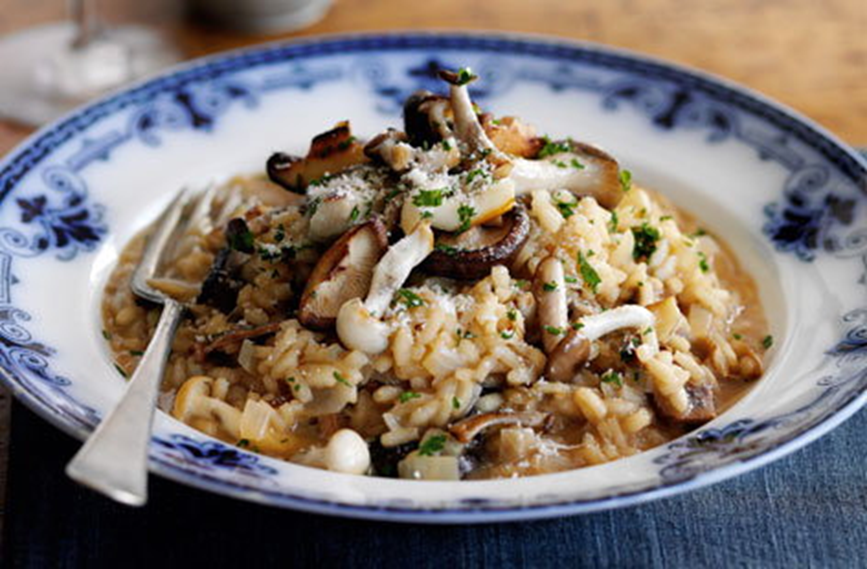
Mushroom risotto

  • 1 handful of chestnut mushrooms
  • OPTIONAL dried porcini mushrooms
  • 2 sticks celery – finely diced
  • 1 white onion, finely diced
  • 1 clove of garlic, crushed
  • 200g risotto rice
  • Splash of white wine (save a glass for yourself)
  • 1 pint stock (chicken/vegetable, whatever takes your fancy)
  • Parmesan cheese
  • Knob of butter (cold, to be stirred in right at the end)
  • OPTIONAL glug of Worcestershire sauce or mushroom ketchup

Make your stock and pop the porcini mushrooms in, if you have them, and keep it warm. Fry the onion, garlic and celery in a large saucepan with a little bit of butter and olive oil until soft (ideally ten minutes, very low heat). Pour the risotto rice in and, stirring often, let the rice soak up some of the oil and butter. Once the rice starts to stick a bit, pour in the white wine, let that bubble away as the rice soaks it up before slowly adding a ladle-full of stock in. Continue this way, allowing the rice to soak up the liquid, between each ladle full, until the rice is soft but still a little bit chewy and moist. You’re almost teasingly feeding it liquid ladle-full by ladle-full – just as it has drunk up one, the next goes in. Take it off the heat once all the stock has been used, and grate in the parmesan, stirring it round so it melts into the risotto.

Finally, add some seasoning and a lump of cold butter and let it ooze in and cover the pan for a few impatient minutes. It should still just be moist – the Italians spoon it onto a plate and jiggle the plate around in circular motions to allow the risotto to rest in an even flat disc, so it must still retain some moisture and ooziness to do this.

Scatter the parsley on top as a garnish – or even the celery leaves as they are tasty, nutritious and shouldn’t be wasted.

Don’t do anything else for the rest of the day.

Bits from the stove . . .

The middle of January is always hard, I think.  Usually not great weather and still recovering from the festive season – both in spirit and financially! Trying to keep to resolutions and cope with Dry January, it’s nice to think of something to cook that is both comfort food and pennywise.  Make this stew on a dark, dismal afternoon and have it as a TV dinner, watching your favourite comedy and you will soon be cheered up.

Stovies – The word Stovies means “bits from the stove,” so it is a recipe using whatever you happen to have to hand on a Monday, after your Sunday roast – although you can always use fresh meats, too.

  • 1 dessertspoon lard (or beef dripping or oil)
  • 1 onion, skinned and roughly diced
  • Optional: 4 tablespoons dark beer (or stout)
  • 2 ounces roast beef (or lamb, cold and diced)
  • 3/4 lb potatoes (washed, peeled, and cut into quarters)
  • 6 fluid ounces beef stock (or lamb stock or leftover gravy)
  • Vegetables (any that you have left-over from the day before)
  • Salt and pepper

Preheat the oven to 190 C / Gas 5. Place a casserole dish, on the stove over medium heat. Add the lard or dripping, and melt. Add the onions and cook until soft, but not browned – about 5 to 8 minutes. Take care not to burn the onions. If using, add the beer or stout and turn the heat up and allow to boil for 2 minutes to burn the alcohol away. Add the meat and stir well. Add the potatoes in layers, seasoning each layer with salt and pepper as you go, before adding the next layer. Pour over the stock or gravy (or both). Cover with a lid and cook in the preheated oven for 45 to 50 minutes, checking from time to time to make sure the stock is not boiling dry. If it is, add a little extra stock. Ten minutes before the end of cooking, add any leftover vegetables, stir well, and check the seasoning. Cover with the lid and cook for a further 10 minutes. The meat and vegetables will break up to create a thick, hearty stew-like consistency. Be careful not to over boil, as you need to keep chunks of meat and vegetables. Serve the stovies in a deep dish or bowl with rough oatcakes and brown sauce, if you like it.

Variations – Don’t feel that you have to be restricted to the pickings from your Sunday lunch. Stovies can also be made using a tin of corned beef, some cooked minced beef, or sausages:

  • Corned Beef: Crumble the corned beef and stir through your potatoes 20 minutes before the end of cooking.
  • Cooked Minced Beef: Stir through the potatoes 20 minutes before the end of cooking.
  • Sausages: Cook the onions as above. Using 1 pound of sausage, slice thickly then put one layer on the onions, followed by a layer of potatoes. Continue until all used up. Cook as above.