Some hae meat and canna eat,And some wad eat that want it,But we hae meat and we can eat,And sae the Lord be thankit.

There are two things which always take me back to my roots and like to celebrate – Hogmanay and Burns Night.  The former has no particular culinary history (a lot of alcohol and emotional singing of Auld Land Syne). The latter, of course, has the Burns Supper. Haggis, neeps and tatties are a given and can really only be served one way – but you may not know the following 2 recipes.

Cullen Skink – a hearty soup made from leeks, onions, potatoes and smoked haddock

  • 50 grams butter
  • 1 small onion and 1 small leek, finely chopped
  • 2 medium potatoes, peeled and cut into cubes
  • 150 ml water
  • 200g (ish) smoked haddock
  • 200 ml milk

Melt butter and leek in a saucepan and cook for about 5 minutes without browning. Add potatoes and cook till soft. In another pan cover the haddock with the milk and cook gently till tender (you can also do this in the microwave). Remove from milk when cool and flake gently into large pieces, removing bones. Drain the potatoes (keeping the water), take out some of them with some leeks and onions and mash the rest. Return the vegetables to the pan with the liquid and add the milk and haddock.  You may need more liquid – you can add some more milk, white wine and/or cream or creme fraiche – whichever takes your fancy. You can also add some chopped parsley and/or chives for a bit of colour. Serve with lots of crusty bread to mop up.

Cranachan a delicious mix of raspberries, cream, whisky, honey and toasted oats.  What’s not to like?

  • 100 grams porridge oats
  • medium pot of double cream
  • 2 – 3 tablespoons honey to taste
  • 2 – 3 tablespoons whisky (I personally hate whisky but somehow can take it here!)
  • raspberries – fresh or frozen

Heat a heavy based frying pan up and toast the oats until nutty and pale brown (I sometimes add a little demerara sugar so they caramelize but you do have to keep moving them around!). Put to one side to cool. Whip the cream till soft peaks and fold in the honey and whisky. Layer up the cream, raspberries and oats and eat immediately whilst the oats are still crunchy.

ps One of the greatest myths about the Selkirk Grace (heading above) is that it was written by Robert Burns. He was said to have delivered the grace at a dinner party, held by the Earl of Selkirk in 1794. However, at that time, the Selkirk Grace was already 80-100 years old, and was originally called the Galloway Grace or the Covenanters’ Grace. Burns, a well known individual of the time, brought some popularity to the grace, which is why people began to call it the Selkirk Grace, as his speech in Selkirk became well known. Rabbie was known to recite it at many dinners, and so people often mistakenly thought that he wrote it.

Auld Lang Syne (which was written by him) is sung at the end of Burn’s night. A song about forgiveness, friendship, and new beginnings.

Bits from the stove . . .

The middle of January is always hard, I think.  Usually not great weather and still recovering from the festive season – both in spirit and financially! Trying to keep to resolutions and cope with Dry January, it’s nice to think of something to cook that is both comfort food and pennywise.  Make this stew on a dark, dismal afternoon and have it as a TV dinner, watching your favourite comedy and you will soon be cheered up.

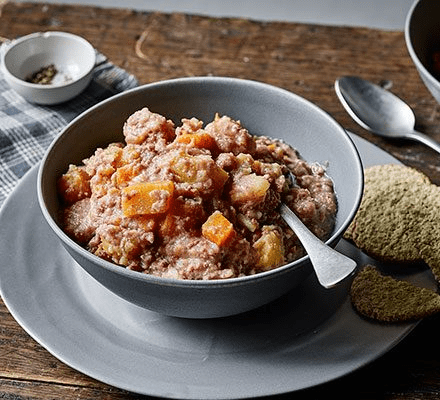
Stovies – The word Stovies means “bits from the stove,” so it is a recipe using whatever you happen to have to hand on a Monday, after your Sunday roast – although you can always use fresh meats, too.

  • 1 dessertspoon lard (or beef dripping or oil)
  • 1 onion, skinned and roughly diced
  • Optional: 4 tablespoons dark beer (or stout)
  • 2 ounces roast beef (or lamb, cold and diced)
  • 3/4 lb potatoes (washed, peeled, and cut into quarters)
  • 6 fluid ounces beef stock (or lamb stock or leftover gravy)
  • Vegetables (any that you have left-over from the day before)
  • Salt and pepper

Preheat the oven to 190 C / Gas 5. Place a casserole dish, on the stove over medium heat. Add the lard or dripping, and melt. Add the onions and cook until soft, but not browned – about 5 to 8 minutes. Take care not to burn the onions. If using, add the beer or stout and turn the heat up and allow to boil for 2 minutes to burn the alcohol away. Add the meat and stir well. Add the potatoes in layers, seasoning each layer with salt and pepper as you go, before adding the next layer. Pour over the stock or gravy (or both). Cover with a lid and cook in the preheated oven for 45 to 50 minutes, checking from time to time to make sure the stock is not boiling dry. If it is, add a little extra stock. Ten minutes before the end of cooking, add any leftover vegetables, stir well, and check the seasoning. Cover with the lid and cook for a further 10 minutes. The meat and vegetables will break up to create a thick, hearty stew-like consistency. Be careful not to over boil, as you need to keep chunks of meat and vegetables. Serve the stovies in a deep dish or bowl with rough oatcakes and brown sauce, if you like it.

Variations – Don’t feel that you have to be restricted to the pickings from your Sunday lunch. Stovies can also be made using a tin of corned beef, some cooked minced beef, or sausages:

  • Corned Beef: Crumble the corned beef and stir through your potatoes 20 minutes before the end of cooking.
  • Cooked Minced Beef: Stir through the potatoes 20 minutes before the end of cooking.
  • Sausages: Cook the onions as above. Using 1 pound of sausage, slice thickly then put one layer on the onions, followed by a layer of potatoes. Continue until all used up. Cook as above.

Happy New Year!

New Year – new look – and an update of why we/you are here.

This cookery blog is a collection of some favourite recipes written at my kitchen table, using ingredients you can find locally and in season. Personally, I love the changes and wouldn’t want to live anywhere other than the UK with all its climate and regional diversities.  I look forward to the first asparagus from the farm just around the corner, English strawberries from the local market, the freshest fish from our British waters, field mushrooms from an autumn walk.

With less carbon footprint and more freshness, you will soon understand why eating British and following the months will tickle your tastebuds, save you some pennies and help local economy.

I live in Worcestershire with The Husband, one cat and with visiting children and grandchildren. as and when. In my time, I have been a nurse, made children’s clothes, had a catering company, estate agent and for the last 16 years volunteered, helping with arts and crafts, at a local Hospice.  It was there that I was encouraged to start www.ailsacooks4one.com after taking in recipes for those bereaved and having to cook just for themselves.  I want to give you the love of cooking I have and the confidence to do so for others. 

And, now, I want to get everyone else onboard, following the Seasons!

It wasn’t so long ago that every meal people ate was prepared using seasonal ingredients because there was no means of transporting international produce between countries.  People ate as nature intended and their diet was dictated by what grew locally.  There really is no sense or benefit in eating fruit, vegetables, meat and fish that have been flown around the world when you can enjoy native ingredients that have been grown, reared or caught a matter of miles from home.

Every time we look at our plates, we should ask ourselves where the food comes from, how it was produced and what it cost – not just in terms of money but also in terms of environmental damage. To entice us to buy fruits and vegetables, supermarkets lay out stacks of perfectly formed specimens, Unfortunately, this means that 20 – 40% of local farm produce is wasted because it isn’t “perfect” enough even though it tastes absolutely fine.  It also means that to reduce the risk of blemished produce, the former relies more and more on a range of pesticides and fertilisers to keep food available out of season. The fertilisers also cause massive problems in the environment as soil biodiversity and water course are polluted by the run off from fields.

Locally grown will often cost less, will be fresher, tastier and more nutritious. It will be less damaging to the Earth due to the reduction in energy used to transport far flung places. You will also be supporting farmers and producers in your area and, in turn, helping the local economy.

We can change things for the better by:

  • accepting “wonky” or less than perfect vegetables and fruit
  • Grow your own.
  • Eat by the Season

Spring is traditionally a time of culinary celebration after the Winter months.  Fresh green produce, various meats and berries begin to appear. By the Summer the harvest from land and sea is in progress and many fruit and vegetables are plentiful.  With the advent of Autumn, there is still much about and will now include wild mushrooms, British apples and pears and nuts.  Winter is not the dull culinary season many people think it is with game and winter vegetables that need a touch of frost to bring them to their peak.

January 5th I know it’s a bit of a cliché and perhaps because I am a Scot and brought up in the tradition of Hogmanay but I love New Year’s Day.  I see a whole year before me stretching out just waiting to be filled with people and places and happenings!  Some will be bad as well as good but I’ll take that for a chance at newness and anticipation for a year to come. And my main resolution this year – to try to cook seasonally – as I hope you will!

Make the best of the month’s offerings with warming soups and casseroles and seasonal cooking will never feel so wholesome.

Anything-you-Have Coconut Curry Soup the best soup using leftover veg.

  • 1 tablespoon of olive oil
  • 1 chopped onion
  • 1 -2 cloves garlic, smashed
  • small knob of ginger, grated
  • 1 tablespoon red curry paste
  • 1 tablespoon turmeric
  • salt to taste
  • 1 dessertspoon sugar
  • 1 14 ounce can of coconut milk
  • 1 pint vegetable stock (from a cube will do)
  • the fun part – any vegetables you have in the house!  You can add:
  • potatoes/sweet potatoes/parsnips/carrots/courgettes/peppers/mushrooms/spinach

Heat the oil in a large pot over a medium heat.  Add the onion, garlic and ginger and stir fry for a few minutes. Add the curry paste, turmeric, salt and sugar.  Stir fry again to combine.  Add the coconut milk and stock – and whatever lost vegetables you have found!  Simmer until soft, blend to silky smooth and serve with some crispy fried onions and/or coriander on top.

This is obviously going to make more than more portion – but it will keep in a pot in the fridge for about a week – or you can freeze it in your own sized portions!

Winter Salads

AS we head towards the time when we turn the clocks back and Autumn seems to be rain and cold and grey, try to remember the foods of summer, their freshness and greeness. Whilst the weather often dictates that stews and comfort food are what we want/need to eat, don’t forget winter salads – but with a hint of warmth to keep out the chill. You can eat them on their own – but they will easily sit happily alongside lamb or pork chops or baked fish – and give you a quick boost of Vitamin C and all things sunshine!

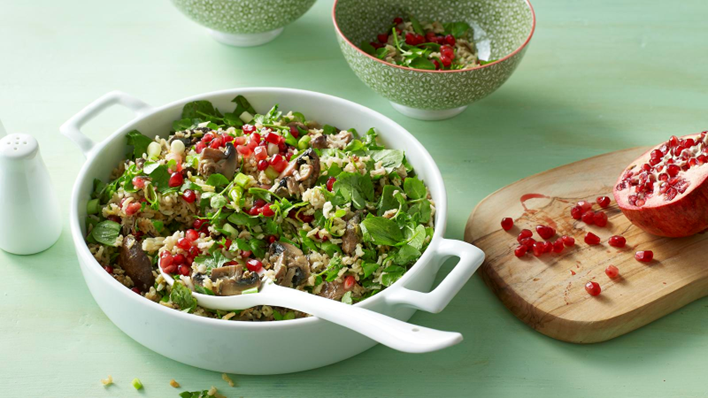
Mushroom and Wild Rice Salad

  • 125g chestnut mushrooms, halved
  • 1/2 onion, finely chopped
  • 1 garlic cloves, crushed
  • 1/2 unwaxed lemon, finely grated zest only
  • 75 – 100g mix of brown basmati and wild rice, cooked (you could use one of the ready made pouches )
  • 200ml hot vegetable stock
  • 1 pomegranate, seeds only
  • 3 – 6 spring onions, finely chopped
  • 50g watercress, roughly chopped
  • 1 tbsp extra virgin olive oil
  • fresh coriander, roughly chopped               
  • 1 tbsp lemon juice  
  • Salt and pepper                                         

Preheat the oven to 200C/180C Fan/Gas 6. Place the mushrooms, onion, garlic, lemon zest, rice and vegetable stock in a casserole dish or small, deep roasting tin. Cover tightly with kitchen foil or a lid and cook for 1 hour.

Meanwhile, to make the lemon and coriander dressing, mix all the ingredients together in a small bowl. Set aside. Stir the dressing, half the pomegranate seeds, half the spring onions and the watercress into the rice. Taste and adjust the seasoning, if needed. Garnish with the remaining pomegranate seeds and spring onions. Serve immediately.

Thai Vegetable Salad with Crispy Noodles (Optional)

  • 2 carrots, peeled and pared into ribbons
  • 1/2 red onion, peeled and thinly sliced
  • 1 small cucumber, thinly sliced
  • 2 – 3 tomatoes, chopped
  • 1/2 little gem lettuce
  • Bean sprouts
  • small can of water chestnuts, drained and halved (you can freeze what you don’t need for another time)
  • 1 red chilli
  • 1 garlic clove
  • Add chopped mushrooms (raw), sliced peppers, radishes, cashew nuts, coriander, sliced cabbage, seeds of your choice

Dressing:

  • 1 tablespoon sesame oil                                       
  • 1 tablespoon vegetable/sunflower oil
  • 1/2 teaspoon grated ginger                                  
  • 1 teaspoon castor sugar
  • 1 dessertspoon sherry vinegar                           
  • 1 tablespoon soy sauce
  • 2 tablespoons water

Deseed and finely chop chilli; peel and slice garlic. Heat the oil and fry the chilli, garlic and ginger for 30 seconds.  Add the sugar, vinegar, soy sauce and water and simmer for 1 minute.  Remove from heat and cool. Put all the salad ingredients in a large bowl. Add the dressing and toss well. Serve at once with a scattering of sesame seeds

Try topping with Crispy Noodles (soak half a sheet of dried Chinese egg thread noodles, drain and dry thoroughly. Heat some oil in a deep pan and deep fry the noodles for 1 -2 minutes until crisp and golden.

Pear Salad

  • 3 Tablespoon extra-virgin olive oil, divided
  • 2 pears, quartered lengthwise and cored
  • salt
  • Freshly ground black pepper
  • 2 Tablespoon apple cider vinegar or sherry vinegar, divided
  • 2 tsp. honey
  • 1 /2 head of a romaine or other crispy lettuce, torn into bite-sized pieces
  • crumbled blue cheese or feta
  • seeds and/or walnuts (optional)

In a large pan, over medium-high heat, heat 1 tablespoon oil until just smoking. Add pears in a single layer cut side down and cook, flipping halfway through, until golden brown on both cut sides, 4 to 6 minutes total; season with salt and pepper. Reduce the heat to low and add 1/2 tablespoon vinegar. Gently stir until liquid is thickened and coats pears, 1 to 2 minutes. Transfer pears to a plate and let cool. Halve each piece of pear lengthwise.

In a large bowl, whisk honey and remaining oil and vinegar; season with salt and pepper. Fold in greens, gently tossing to combine. Top with pear slices and blue cheese.  You can also add your favourite seeds and/or walnuts.