
When I first started this blog it was to, hopefully, get those of you cooking for one to get back into the way of shopping, preparing and eating delicious, healthy meals when you may not have thought it worth the effort. I thus said that there was to be no batch cooking as it defeated the object of getting you out and about food shopping and giving the pleasure of cooking.
HOWEVER, today’s recipes are for cooking in a slow cooker and as it’s more difficult to cook a small amount in one, this time it’s one meal for you and one for the freezer (or a friend.) With the coming of Winter and colder times, it makes sense to have something in hand in case you can’t get out because of the weather.
Why slow cook? Basically, once you have prepared all the ingredients and put them in the pot, the food can be left to its own devices, requiring minimal further effort , so you can go out for the day, spend time in the garden, paint a room – and return to a perfectly cooked meal.
Slow cooking makes economic sense, too, as it works best using cheaper cuts of meat and inexpensive staples such as beans and lentils. It is also easy to cook larger quantities at once, creating leftovers for another day or to freeze. Stews, casseroles and pot roasts are real comfort food.
Energywise, slow cooking is great – don’t be put off when you see the recipe saying switch on and slow cook for 8 hours!
- Cooking time: 8 hours
- Energy used:200 watts x 8 hours = 1600 Wh or 1.6 kWh
- Cost: If your energy rate is 20p per kWh, the cost would be 1.6 kWh x 20p = 32p.
Tips for success
For maximum flavour, brown the meat at the start of the cooking ie lightly fry and soften aromatic vegetables such as onions and garlic in the same pan afterwards.
Be careful not to over season as salty flavours become concentrated with slow cooking. You ca always adjust at the end.
Peppercorns and seeds, such as cumin and coriander are best crushed before adding to the pot so they release their flavour slowly.
Woody herbs such as rosemary and thyme are robust enough to add at the beginning of cooking whilst delicate herbs like parsley towards the end.
Always add delicate ingredients that don’t need much cooking such as fish and seafood towards the end of the cooking time.
If topping up the liquid during the cooking, add HOT liquid to prevent lowering the cooking temperature.
Make sure all frozen ingredients are thawed and meats thoroughly defrosted before cooking.
If a recipe calls for milk add this for the last 30 minutes of cooking. Add any cream at the end.
Adapting recipes from conventional cooking to a slow cooking. Look at the basic cooking time – but leave to cook for longer – low, if all day and high, for 3 – 4 hours. A slow cooker will never boil dry. As a general rule, halve the liquid as it doesn’t evaporate. If at the end, it looks like too much liquid, put it onto high with the lid off. You may need to reduce spices and herbs as their flavour becomes concentrated in the slow cooker.
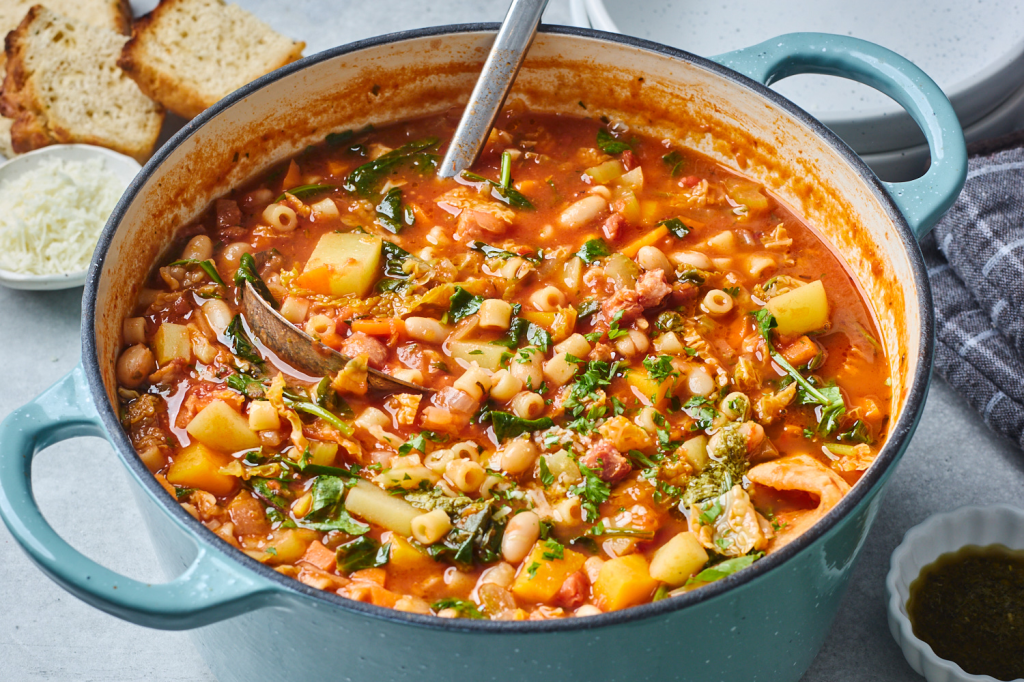
MINESTRONE SOUP Serves 4 – 6
- 2 tablespoon olive oil
- 2 celery sticks, chopped
- 2 carrots, chopped
- 1 onion, chopped
- 400g can chopped tomatoes
- can of cannellini beans (optional)
- 750 ml hot chicken or vegetable stock
- 60g small pasta shapes
- 4 tablespoons chopped parsley
- 40g parmesan cheese
Heat the oil and cook the celery, carrots and onions until softened, Stir in the tomatoes and their juice. Transfer to the cooker and add stock. Cover and cook low 6 – 8 hours. Add the pasta (and beans, if using) for the last 15 minutes of cooking. Stir in the parsley and parmesan.
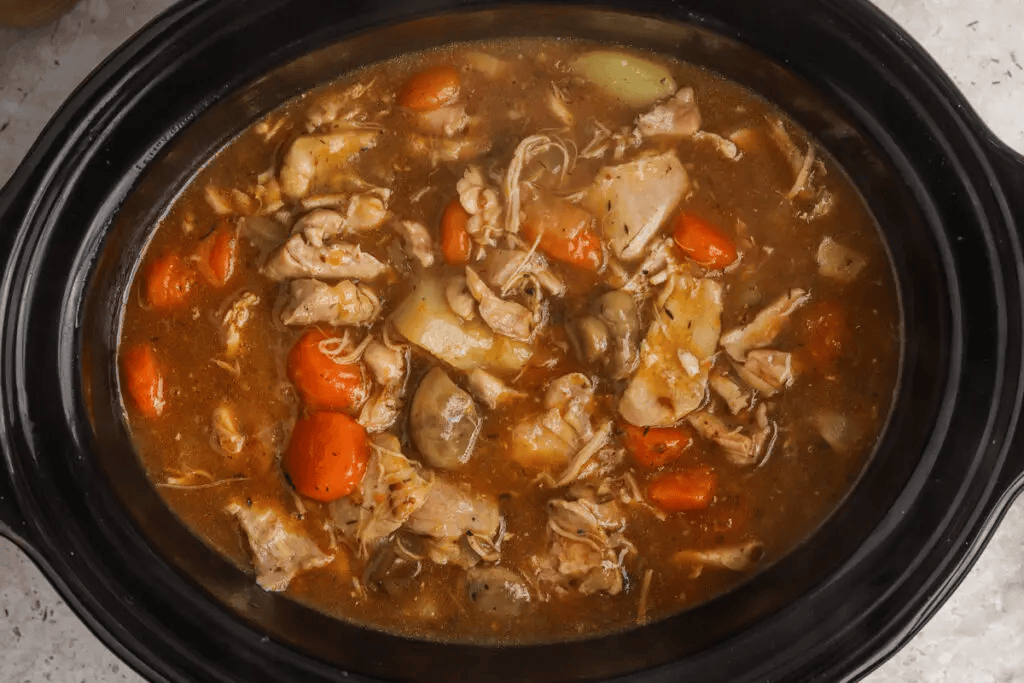
MUSTARD CHICKEN CASSEROLE Serves 4 – 6
- 2 tablespoons wholegrain mustard
- 1 tablespoon English mustard
- 2 tablespoons runny honey
- 8 chicken thighs (bone in, skin off)
- 2 tablespoons olive oil
- 2 -3 onions roughly chopped
- 200g parsnips/200g carrots, peeled and chopped
- 1 pint hot chicken or vegetable stock ( a cube is fine)
Mix together the mustards and honey in a bowl. Season the thighs and smother them with the mustard mix. Leave to marinate for ½ hour. Heat half the oil in a pan and add the chicken pieces, a few at a time. Cook for 6 – 10 minutes until golden. Put the remaining oil and fry the onions for a few minutes, scraping up any of the chicken juices. Add the carrots and parsnips. Put everything into the cooker, pour in the stock and add the chicken. Put the lid on and cook on low for 6 hours or High for 3 – 4 hours.
RED CABBAGE WITH CIDER Serves 4
- ½ red onion
- 1 large red cabbage
- 1 apple, cored but not peeled, finely chopped
- 1 teaspoon 5 spice powder
- 300ml cider
Put the onion, cabbage, apple and 5spice powder into the cooker. Season. Pour in the cider and stir to mix well. Cook on low for 8 hours or high for 4 hours.
NB If you haven’t got a slow cooker, all of the above can be adapted for the oven, cooking at about 150C to 180C till tender.

